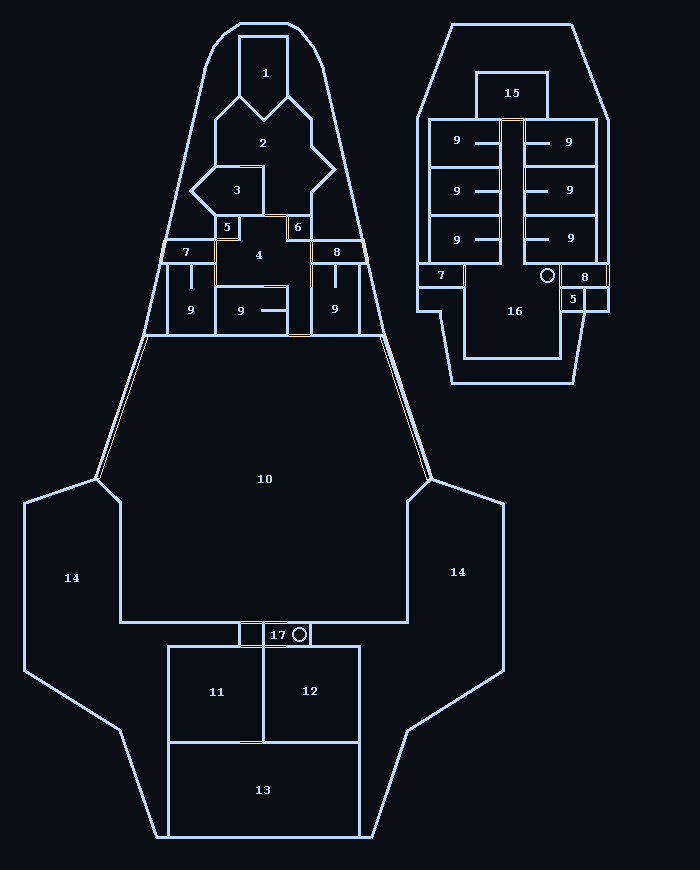
2. Bridge
3. Office
4. Common room
5. Fresher
6. Ship's locker
7. Escape pod
8. Airlock
9. Stateroom
10. Cargo bay
11. Power plant
12. Cryo-sleep
13. Engineering
14. Fuel
15. Med bay
16. Common room
17. Central chute
Sensors
A short ladder and hatch on the side of the wall next to the sensors console allows access to the equipment attached. The space itself is nearly completely occupied by radar and lidar machinery, with rungs that run in a loop around the room from the hatch. Grav plating is absent in this room. A hatch on the opposite side of the room from the bridge access leads to the ventral jefferies tube.
Bridge
A small room shorter in height toward the fore than the entrance with three control stations and a computer bank. The floor is a mosaic of different-sized grav plating tiles, fit as best as possible around the bases of the control stations. The uneven diagonal edge of large square plates crawling under the triangular control stations gives your feet a strange cold, weightlessness as you sit at the console. A large window of double-paned, reinforced glass arcs overhead in the front half of the ceiling. With the right angle, one can see the patina of dust and several grains of sand trapped between the panes- assumedly the source of the delicate spiderweb of scratches that shine in the right angle of light. A square room with a window by its door facing the pilot’s console juts into the space.
Office
The door in the entrance of the office’s forward side rattles a bit due to a poor retrofit. The window to the right of the door has a set of mechanical blinds that groan when opened all the way. The ship’s main computer occupies the port side of the office’s wall, and sprawls into the bridge through a bundle of cables fed through a hole in the base of the wall. A desk built into the aft wall holds a week’s worth of moderate clutter in several different handwritings. On the starboard side, a wooden desk has been screwed into place and a filing cabinet made of plywood created in the gap between it and the forward wall. If the bottom drawer is removed and the loose grav plating tile slid back, a narrow smuggler’s compartment lined with lead stretches into darkness.
Common room (crew deck)
A small room slightly larger than the bridge remains mostly empty - if it’s put away properly. Nets low on the aft walls hold a table and folding chairs, and a small kitchenette folds down above them. Doors to three staterooms enter into the aft side of the space, two from the port and starboard sides. The forward wall houses the shower, a fridge, the entrance to the bridge, and the ship’s locker. The main airlock is centered in the starboard wall, and the escape pods opposite on the port side. A narrow hallway to the cargo bay exits aft.
Fresher
A mostly clean shower with a UV light in the ceiling. Several people’s soaps stack in the corners - even a candle. A sink and toilet fold down from the port and starboard walls, and a combination washer & dryer pulls down from the ceiling.
Ship's Locker
A closet lined with shelves with enough space for one person to mostly stand between. This particular locker is packed full of emergency supplies and small arms. Nothing is in its original packaging.
Airlock
A locker with emergency softsuits is built into the aft wall, and a larger closet for bulkier vacc suits is built into the fore. This airlock lacks grav plating.
Stateroom
A small room with a standardized design: two foldaway beds, a desk and cabinets built into the wall, and a sink and toilet.
Cargo bay
The tight spaces of the rest of the ship open into a cavernous cargo bay. A gantry crane on tracks running from fore to aft dominates the top of the space. A short ladder leads up to the entrance to the forward common room, and two doors aside each other on the aft wall lead to engineering and the upper deck, turrets, and cryo storage. Hatches in the floor in center of the fore and aft walls lead to the ventral jefferies tube, and the catwalk above the crane opens to the dorsal jefferies tube.
Power plant
A fusion generator drones loudly in the vast majority of the room. Modern models tend to have much more shielding than this one does. The aft-most entrance to the ventral jefferies tube is just beside the door to engineering.
Cryo-sleep
Four rows of five cryo-sleep pods from port to starboard cascade a bundle of cables down their backs to the aft wall, tubes draped up into the ceiling. ITO-3 has a droid here made from a refit autodoc confined to a track in the ceiling running down each row and across in the fore and aft.
Engineering
A computer station and workbench is built into the starboard half of the forward wall. The traditionally cramped space is made even tighter with the addition of the reaction drive’s twin nozzles in the aft corners of the room.
Fuel
Were you to get inside of these, you could follow a snake-shaped route between stainless steel baffles reaching from floor to ceiling the height of the cargo bay. A terran would also go deaf from the echoes of the fuel refineries at their forward end.
Med bay
ITO-3’s droid is suspended from an armature in the center of the ceiling. Two beds with monitoring equipment are built into the forward wall. Locked, opaque cabinets full of neatly organized supplies are built into each of the other three walls. The sliding door in the aft wall is held open with a piece of plastic duct tape.
Common room (passenger deck)
The larger common room on the upper deck has a full-size kitchen along the port wall, and a large wooden table screwed into the floor. A pack of cards sit on the table, and a dart board and collapsible grav ball goals are set into nets along the aft wall.
Central chute
A ladder set in front of the cryo-sleep storage connects the ventral turret, the ventral jefferies tube, the main deck, the dorsal jefferies tube, the passenger deck, and the dorsal turret.